“My life’s work” — This is how Prof Liesl van der Merwe describes her latest research article, published less than two weeks ago in the International Journal of Qualitative Studies on Health and Well-being. This “theory of joyful experiences in Dalcroze Eurhythmics” is the result of more than a decade of research, which culminated in her inaugural lecture in 2023 and was further distilled in this article.
This article deeply examines what makes people experience joy when they participate in Dalcroze Eurhythmics sessions — an approach to music education that combines movement and music. Prof van der Merwe gathered and carefully analysed 49 qualitative studies focusing on how individuals experience joy during these sessions. Using a research approach called meta-synthesis and a computer program called ATLAS,ti, she sorted through all the details in these studies by “noticing,” “collecting,” and “thinking” about the data. This process allowed her to see common patterns and connections in what made the sessions joyful.
The research found three main ingredients for joy in Dalcroze sessions.
- Active engagement is crucial. When fully involved in fun, movement-based activities, participants tend to feel a burst of energy and delight.
- Social interaction plays a key role. When people connect, share experiences, and feel safe in a non-judgmental, cooperative environment, they experience a deeper sense of joy.
- Achievements matter, too. As students progress in their musical skills and feel a sense of accomplishment, their joy grows.
The emerging theory explains that these positive experiences create a kind of “upward spiral.” When people feel joy, they become more open-minded, creative, and connected with others. Experiencing joy improves their musicianship and enhances their overall well-being — emotionally, physically, and spiritually. However, the research also points out that excessive competition, judgmental attitudes, or past traumas can block joy.
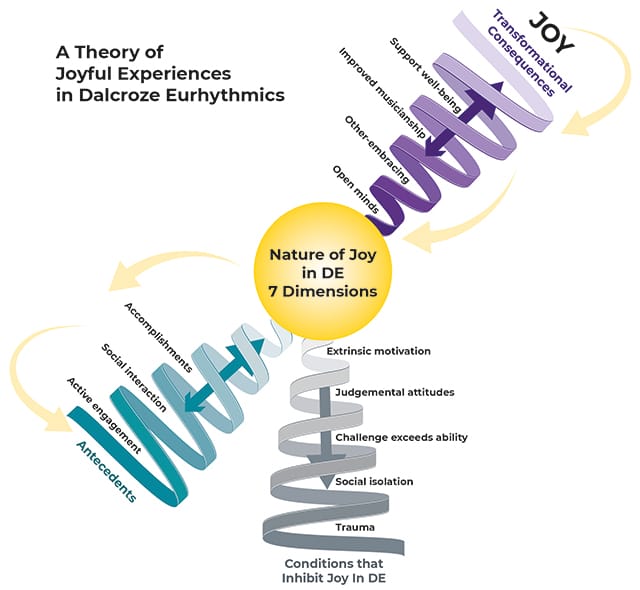
In short, the study shows that Dalcroze Eurhythmics can be a powerful way to boost joy and well-being through active learning, supportive social interactions, and the satisfaction of overcoming challenges. This theory gives educators a clear framework for designing classes that maximise positive, joyful experiences for all participants.
=====
Van der Merwe, L. (2025). A theory of joyful experiences in Dalcroze Eurhythmics. International Journal of Qualitative Studies on Health and Well-Being, 20(1). https://doi.org/10.1080/17482631.2025.2468050